Sleek one-page Portfolio Webflow cloneable
Create a sleek one-page Webflow cloneable by Jordan Hughes. This minimalistic template features Untitled UI, Relume design systems, and engages Client-first methodologies for a polished look. Ideal for freelancers and small businesses, it offers easy navigation and responsive design for seamless user experience.

About cloneable
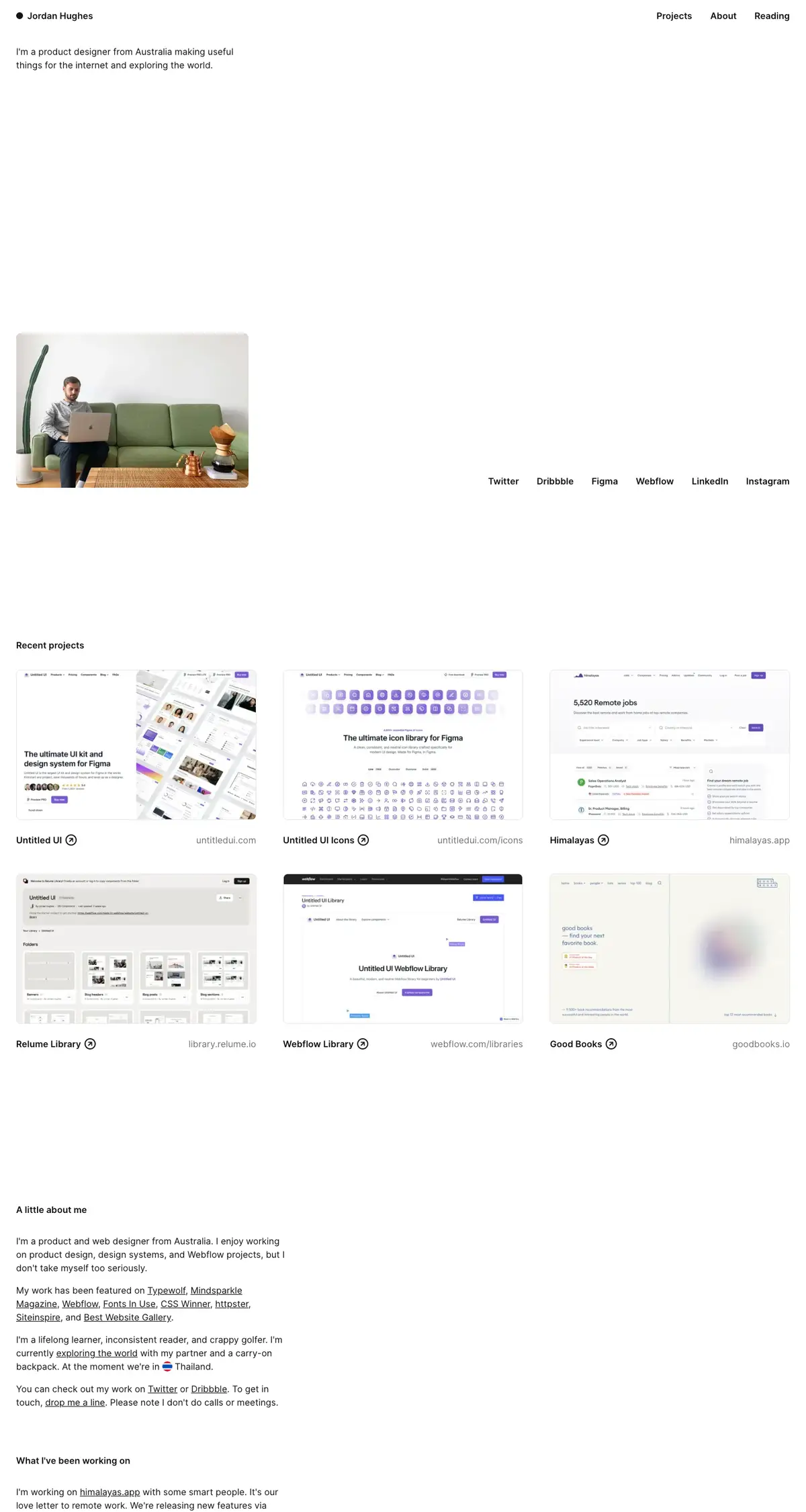
Designed by Jordan Hughes, this Webflow cloneable embodies a sleek and minimalistic one-page layout that caters to users needing a refined online presence. Built within a rapid two-day timeframe, this template combines cutting-edge design systems like Untitled UI, Relume, and Client-first methodologies, ensuring a polished, professional look that seamlessly integrates into various creative projects.
With a contemporary typeface—Suisse Int’l, alongside a free alternative, Inter—this cloneable is visually cohesive, making it ideal for product designers, freelancers, and small business owners seeking to establish their brand in the digital space. The template features straightforward navigation, encompassing sections such as "Projects," "About," and "Reading," allowing visitors to easily connect with the content.
Users implementing this template into their Webflow sites will benefit from the well-structured layout, enhancing user experience and engagement. The use of responsive design ensures that all elements adapt gracefully across devices, while the incorporation of JavaScript libraries and custom CSS provides additional functionality and aesthetic appeal.
The cloneable also incorporates analytics tools, enabling users to monitor site performance and visitor interactions, thereby facilitating data-driven decisions for their branding strategies. By leveraging this thoughtfully crafted template, Webflow users can effortlessly create an impactful online portfolio or personal website, ultimately enhancing their professional landscape and connecting with potential clients or collaborators.
About CSS
What is the purpose of the CSS code targeting specific data-w-id attributes in Webflow?
This CSS code contains styles targeted at specific elements identified by unique data-w-id attributes, which are often used in Webflow for managing interactions and animations. The code applies transformations that translate elements to a position off-screen (specifically, downwards by 100% relative to their original position) while ensuring that they maintain their scale and rotation settings. Each of these elements is designed to behave the same way through the use of the transform property, allowing for consistent animations based on user interactions or page load events.
How does the CSS handle different screen sizes in Webflow?
The CSS includes media queries that provide different styling rules based on the screen width. For screens wider than 992 pixels (desktop) and for the range of 768 to 991 pixels (tablet), the same transformations are applied to the same set of elements. This allows developers using Webflow to make sure that elements are presented or animated in a consistent manner across different device sizes, maintaining a responsive design approach.
What is the purpose of controlling opacity and blur in Webflow?
In a specific section of the CSS, there is a rule that sets the opacity of an element to 0 and applies a blur filter of 24 pixels. This can be used in Webflow to create an effect where certain elements are visually hidden or softened, perhaps until a certain interaction occurs, such as a scroll or a click. This technique can help in enhancing visual emphasis and ensuring a better user experience by drawing attention to the right elements at the right times.
How do classes like .clickable-off and .clickable-on function within Webflow?
The classes .clickable-off and .clickable-on manipulate the pointer-events property. When an element has the class .clickable-off, it disables all click and hover interactions, effectively making it non-interactive, which could be useful during loading phases or when specific user actions are not applicable. Conversely, .clickable-on allows interactions to be enabled, making the elements responsive to user actions. This is particularly useful in Webflow when creating dynamic interfaces that respond to user inputs.
What does the .div-square class achieve in this CSS?
The class .div-square uses a pseudo-element ::after with padding-bottom set to 100%, which helps maintain a 1:1 aspect ratio, ensuring that the element always remains square regardless of its width. This is a common technique used in CSS to create responsive square containers, making it ideal for layout designs in Webflow that require visual consistency across various content types.
What are the implications of removing focus outlines in Webflow with main:focus-visible?
Removing the focus outline for the main content element using outline: -webkit-focus-ring-color auto 0px; is an approach to enhance the visual design by removing the default focus borders that appear when an element is navigated to via keyboard (e.g., Tab key). While this helps in maintaining aesthetics, developers must be cautious, as it can impact accessibility for keyboard users. It's recommended to ensure other form of visual feedback (like color changes) is provided to indicate focus in a user-friendly manner.
Do external libraries affect the implementation of this CSS in Webflow?
Although the CSS provided does not reference any external libraries directly, many Webflow projects often utilize JavaScript libraries (like jQuery) that can be integrated for more dynamic interactions. The CSS behavior can be enhanced or manipulated further using these libraries, allowing developers to control animations, transitions or character interactions upon user engagement, often complementing the foundational styles established in the CSS.
About Javascript
How does the Html5Shiv.js library work in a Webflow context?
Html5Shiv.js is a JavaScript library designed to enable support for HTML5 elements in older versions of Internet Explorer (specifically IE 8 and below). In a Webflow project, including Html5Shiv.js ensures that newer HTML5 elements are recognized and displayed properly across browsers that do not natively support them, contributing to better cross-browser compatibility for responsive designs.
What does the gtag function do in relation to Webflow and Google Analytics?
The gtag function is a part of Google Tag Manager. In the context of Webflow, it pushes tracking information (like page views or events) to the Google Analytics service. The function initializes tracking and configures analytical parameters such as anonymizing IP addresses, which enhances user privacy by preventing Google from storing users' full IP addresses.
Why are async attributes used in the script tags for Google services in Webflow?
The async attributes in the script tags are used to load the Google services scripts asynchronously, meaning they will load in parallel with other elements of the website instead of blocking the rendering of the page. This improves page load performance, which is crucial for user experience and SEO when creating websites in Webflow.
How does the Placeholders.js library enhance forms created in Webflow?
Placeholders.js is a library that enables the display of placeholder text in older browsers that do not support the HTML5 placeholder attribute for input fields. In the context of a Webflow site, this library ensures that all users, regardless of their browser, can see instructional text in form fields, enhancing usability and improving form completion rates.
What is the role of the Webflow script sourced in the provided code?
The Webflow script included in the code is essential for enabling the interactions and animations built within the Webflow platform. It ensures that all design elements and responsive features function properly, enabling users to experience the intended visual and interactive effects created by designers on the Webflow platform.
How do these JavaScript libraries integrate with each other in a Webflow environment?
The JavaScript libraries included work synergistically to enhance both functionality and performance in a Webflow project. Html5Shiv ensures compatibility with older browsers, while Google Analytics and gtag manage user data tracking to inform website improvements. Placeholders.js improves form usability across different browser versions. Together, they ensure a modern, interactive, and fully functional web experience, regardless of browser capabilities.